Showing posts with label Writing. Show all posts

Tuesday, April 17, 2007

Eulogy

As written and read by Ken Franz:


Herman James Franz was born March 19, 1947, in Filadelfia, Chaco, Paraguay, the 2nd of 6 children to Jacob and Helen Franz - missionaries working with the nomadic Chulupii Indian tribes. He was predeceased by his father in 1978.


Jim spent the first years of his life, in a frontier type setting, completing his elementary school education at the local German Mennonite Colony School.


Early on he was a helper; “was can ich helfen”, “what can I help with” he would often say to Mom. He helped with the care of his younger siblings, he helped remove weeds and grass around the house so that snakes could be seen and avoided. When the Chulupii hospital was being built he wanted to help with the mud bricks. He was given permission after promising to carry only one brick at a time.


Jim always enjoyed spending time with the Indians, eating the beans they would cook in their big black cauldrons on an open fire. Their carefree spirit and love for nature probably attracted and influenced him considerably. He was thrilled when they made him his very own slingshot, and would meticulously roll clay marbles and dry them in the sun, just like the Indians did. He loved to target practice and, in time, also brought home a few pigeons for his mother to cook.


At the age of 13, Jim’s spiritual formation was also well underway. One evening after a special Church service his parents were already in the Jeep preparing to leave when they noticed Jim was not with them. They found him kneeling at the front of the church, praying with someone. He was never vocal about his faith and often appeared uncomfortable with religious ritual and form. Yet, he always acknowledged faith in God.


Early on he also demonstrated a keen ability to evaluate critically. Once, after Sunday school he told Dad about what he had learned. He had heard this fantastic story about a man who rode right up into heaven in a blazing chariot pulled by magnificent horses. Then he paused and said, “aber erzaehlen can man so was”, “but you can tell such stories in Sunday school, right?” Dad later lamented to Mom that the teacher had failed in placing too much emphasis on the chariot and horses rather than God’s care for Elijah.


On still another occasion, in his teenage years, he saw the young people doing something called “Bunsching”. They would form a circle and, as couples, skip around to music. He said to his father, "Shau mal Papa, Mennonitisher Tance”, “Look Dad, Mennonite dancing.” Of course he knew that dancing was not allowed among Mennonites at that time, but he had caught the religious loop-hole. As a teen he was quite a mature and critical thinker, often preferring to spend time at home with his family or just reading a good book.


At age 15, his family was transferred to Asuncion, the capital city of Paraguay. Jim shared a room with his two much younger brothers. He taught them how to build and fly kites. Just as he had taught them to catch fire-flies in the Chaco, they now graduated to capturing big hairy tarantulas. They would scoop these spiders into canning jars with punctured metal lids, and keep them under their beds…that is, until Mom found out!!


In Asuncion he attended ACA – an English Missionary School. Since the students were largely American, we all had to pledge allegiance to the USA Monday to Thursday and only sang Oh Canada on Fridays (when many of the Americans would not sing). It was here that Jim developed distaste for patriotism and politics. He was never very patriotic or ethnocentric, but he was loyal. In school when Eleanor got into trouble Jim stuck up for her – she really appreciated that loyalty.


Jim completed Junior High in Asuncion and he knew that, like his older sister and other missionary kids, he would also be returning to Canada to complete his High School education. It was very hard leaving his family at the age of 16, yet he never complained.


He completed grade 10-13 at the Mennonite Educational Institute in Abbotsford and lived with his Uncle Johnny and Aunt Anne Friesen for all but one of those years. In grade 11 his family returned to Canada for one year, so he was able to live with them. Mom returned to Canada for his graduation celebration. At that time she told him how much she had missed him when they were apart. In his quiet and philosophical way he simply acknowledged that, sure, it was not like being at home, but he could understand why they did what they did.


In 1969 his family moved to Canada from Paraguay and Jim, who had been working in Vancouver, was transferred to Abbotsford and joined them in their Abbotsford home. He had become quite independent. At first Mom wanted to make his breakfast and lunch but he simply told her not to bother, he could take care of that himself. In 1972, after a lot of saving and planning, Jim set out for Europe and the Middle East. He planned to go for one year but in fact stayed for three.


He traveled around Europe but spent most of his time as a volunteer in Israel working on the various Kibbutzes. He lived in the Golan Heights during times of conflict, even ended up in bomb shelters, enjoyed nature tours and exploring caves, and, of course, worked hard in the fruit orchards, large gardens and communal farms. He really enjoyed the more free spirited, communal life experienced on the Kibbutz. Perhaps it was an unconscious connection to his earlier childhood among the Chullupii in the Chaco.


It was at one of these Kibitzes where he met this very special girl named Jane. Throughout his school years he had never shown much interest in girls, always just being the shy, quiet and studious type. Here, however, was a girl that was obviously perfect for him. Although they shared many similar interests like reading, love of nature, a dry wit, she was not shy - a perfect compliment for him.


In March, 1975, he returned from Israel and informed his parents that this very good friend - an English girl from Lancashire, was coming to Canada in July. In August they were married, making Coaldale their home. Jim worked first at his uncle’s farm in Lethbridge and Jane got a job in the produce department of IGA. Jim’s siblings first met Jane that Christmas – and she quickly won their hearts with her warm personality and that English accent!


After that Jim worked for the Public Works Department of the City of Coaldale until his early retirement, and Jane began working at the Library, something she still enjoys today.


Their lives were enriched by the arrival of their son, Aaron Jay on September 21, 1980 followed by Simone Emily July 5, 1982. Jim loved his children dearly. Both Aaron and Simone inherited their parent’s love of nature and adventure, as evidenced in their travel and career choices.


Although Jim and Jane lived far from family, they always participated in family gatherings, weddings, special birthdays, and anniversaries. Joint family holidays gave opportunity to reconnect, bond and create great memories at summer family gatherings, first in Vasseux Lake, then in Parksville and the last years in Osoyoos. Celebrating their 25th wedding anniversary in Balfour was also a real highlight. At these holidays Jim enjoyed competitive card games, botchy ball, volley ball, going for long walks (in his trademark shorts and Tillie hat), and just visiting together as a family, sharing good food, conversation and laughter. He introduced our family to Beer chicken – a must now at all reunions. Any visits to Jim and Jane in Coaldale proved to be an experience in wonderful hospitality. If Jane happened to be working, Jim was comfortable taking over the kitchen.


Jim was active and loved the outdoors – a book could be written on the hunting and fishing memories together with good friends Ernie and Dietrich, all born the same year as Jim. He was an expert when it came to “roughing it” - he was adventuresome, but not reckless. A creative gardener – he built a beautiful flower garden and fish pond in their back yard. He shared Jane’s enjoyment of bird watching.


Several memorable holidays included a trip to England, a trip to Paraguay reconnecting with childhood landmarks and friends as well as getting stuck in the mud with their 4x4, going hunting and preparing game the traditional Paraguayan way. Visiting Aaron in Taiwan and other exotic stops two years ago took some convincing on Jane’s part, but he thoroughly enjoyed the experience – seeing first hand the adventuresome life his son was living far away from home! Kayaking through the Broken Islands Group with Jane and friends last summer was also a natural expression of his love for nature and water. Jim and Jane returned from their second Mexico trip only two weeks ago.


Being more private and quiet, Jim was sometimes an enigma. That streak of non-conformity and questioning authority was a natural result of his ability to think critically. In life he never lost his sense of right and wrong, of fairness, and learned through personal experience that life is not always fair. With that he also learned to forgive. He disliked confrontation and was much more a peacemaker – a trait he must have inherited from his father


He had a quiet spirituality that did not force religion but rather let goodness, truth and honesty guide his life. Jim was a unique person, who contributed much to our lives, influenced us more than he realized, and at the end, taught us important lessons about family, love for life, and forgiveness, all without saying too much about it, just living it. Thank you so much Jimmy, Jim, James.


Jim, we already dearly miss you, but we know your spirit is free, even more so than it was as a young boy in the great outdoors of the Grand Chaco. No doubt, you are also enjoying the undivided attention and love of Dad.


As for us, we are thankful to still have Jane, Aaron and Simone and Neil, a constant reminder of you. Loosing you makes them even dearer to us. We look forward to many more family reunions with them and some day in the future, an absolutely glorious reunion all together once again in heaven.


Till we meet again!

__________________________________


As written and read by Aaron Franz


Your parents are a mystery when you’re a child, and that becomes more apparent the older you get… at least to a point.


When I was really young, I would find margarine containers full of ball bearings downstairs. And, there were always these perfectly round hand made balls of clay rolling around under the work bench downstairs. Obviously these were sling shot ammo. When you are 5 years old these things might seem normal, but it still made me wonder.


Finding out that Dad grew up in South America… I think I used to imagine the family living in huts in some kind of Amazon like jungle, which maybe wasn’t that far from the truth, but the mental picture definitely had a Tarzan-like aspect to it.


Discovering that Dad spoke German and Spanish was also something that always intrigued my Sister and I. Sitting around the campfire, there were countless occasions when we would prod him relentlessly to speak Spanish – a sentence or at least one word.… usually to no avail.


Those of you who knew my Dad well – and even those of you that didn’t – know that my Dad was generally a quiet guy. People variously describe him as “level-headed”… or, he was “a subdued guy”… or “he liked to just take it all in.” Doubtless he was modest and rarely spoke of himself.


Later on when I was a teenager, I can remember becoming interested in how it was that my Paraguayan raised father and my British mother ever got together. Well… we aren’t Jewish but… they met in Israel on Kibbutz. At that time I never considered my father to be anything but part of the strict conservative archetype, so it was quite a shock when I found out that the Kibbutz are actually socialist communes. And he spent three straight years over in Europe... renting apartments in Spain and traveling around by ferry between Mediterranean countries. These things were all incomprehensible for me when I was in high school.


But things revealed themselves over the years.


There was the time that Dad, Dietrich, Tom and I were hiking around in West Castle. I think I was about 11. Tom and I had our sling shots, and we were up ahead chasing grouse. We had been practicing on tin cans, but we still missed the grouse every time… and when we did hit them, the rocks would just bounce off their wings. Eventually, Dad walked over and said something like, “gimmie that thing.” So I gave him his sling shot, and he rummaged around on the ground for a couple of suitably round rocks. In three shots, three of those grouse were dead. They were sitting up there in the trees, and he hit them square in the head. Tom and I were understandably awestruck. All of the ammo that I found around the house made a bit more sense after that.


Much more recently, my Mum and Dad came to visit me in Taiwan for three weeks. By all accounts it took some convincing for my Dad to get out there… it was well out of his comfort zone. But as the days went by, and I toured them around the countryside, stories that I had never heard before came out. Traveling on trains and buses again, his time in Europe came back to him as I’m sure it never had before. Every night over dinner the stories would pour out. I’m so happy that we shared those times, and that I got to hear those stories from Dad.


And just this Christmas, I gave Dad a Spanish audio course to help him brush up for future traveling. He studied Spanish everyday for the 4 weeks leading up to their last trip to Mexico, and Mum said that he was more outgoing and confident in using his Spanish on the trip. He planned to continue studying Spanish when they got back. I had good fun trying to convince him to rent a little apartment in Mexico and spend the winters down there.


Many of you know my Dad as an avid hunter and fisherman. I think it’s fair to say that he enjoyed the outdoors more than most people. He was at his prime in Nature… very calm, relaxed, and happy.


Over the years he spent countless days hunting with Dietrich and fishing with Ernie. He actually went off hunting for a week when I was 5 weeks old and left my Mum and me with Agnes. He and Dietrich spent a good part of the last 30 winters in West Castle. They spent over 20 of those winters in a Canvas French Army Tent, until the night Dad awoke to see the Milky Way shining down in all its glory… and realized that the tent was burning down. It was around that time that they moved into the new cabin that Dietrich built.


Dietrich told me about a time when Dad spent the day sitting under a tree… just to prove that you could sit in one spot all day without moving when it’s cold. He was waiting for an animal of course, and he sat there from sunrise until sunset. This wasn’t a story that Dad told people, it was just one those things that he did. He did it to prove to himself that he could. He also said that he would never do it again.


And summers were spent camping and fishing at Payne and Police Lake, Dipping Vat, and the rivers around West Castle. In his canoe or in his belly boat, I think he spent most of his time trying to out fish Jason. There were periods of intensive fish smoking and sausage making that Ernie and Dad both did… and at the next dinner party there was always plenty of the latest recipe to taste and critique.


Grandpa settled in this area when he first came to Canada, and Dad had spent six months here on furlough when he was 11 years old. My parents ended up in Coaldale as part of their back to the land kick. He told me once that he came here intending to become a farmer. That never worked out, but in the last few years, he managed to channel that desire into our yard and garden… I always remember him spending the summer in the vegetable garden, but since he retired he expanded the flower garden, built a rough stone patio, a small pond with goldfish, and a prairie rock garden. It’s the perfect place to spend late summer afternoons with friends, a beer, or a book. He was most proud of the Concorde grape vine that he planted four years ago and tended to daily in the summer. Last summer he harvested 35 pounds of dark purple grapes.


Although I was living outside of Canada for the last few years, we always managed to get on the phone a couple times a month, usually for about an hour, to catch up, tell stories, and talk about our plans for the future. This Christmas I spent a month at home, and he and I sat around the kitchen table every morning for hours talking over tea or mate.


I’m thankful that I got to know my Dad as well as I did.

Sunday, December 03, 2006

consider yourself informed

This is the English Only Zone, also know as the EZ zone (though clearly redundant). We teach in the building on the left, and we all live in the dormitories on the right. One building for the girls, and one for the boys. I've probably mentioned before that I live in the girls dormitory. As you might imagine, this is some sort of dream come true. You can also see our cafeteria in the foreground. I live, eat, and work in this small area. There is no real reason to leave.

Sometimes I do leave for a bike ride though, as I did on Sunday. This is an old section of residential Jinju that is packed into a valley away from the river.

The power distribution in that area seems to have been inspired by some of the Indian cities I've visited.

This is obviously a bad picture, but I took it to illustrate an interesting phenomenon that might be unique to Korea. This appears to be a village. There are no other buildings withing five kilometers. Is that where the farmers that tend to those green houses live?

There seems to be a system in Korea whereby the government plans and contracts the construction of every apartment building to Hyundai, Samsung, and the other conglomerates. Individual apartments are then sold off by the government. Contrast this with our system, in which a developer proposes a building, sells the units at a price set for profit, and begins construction.

Korea's system allows for a housing allocation system, which was recently adjusted to benefit families with three or more children. This is part of the governments campaign to bring up the birthrate. If you didn't know, Korea is a country full of dinks - that is "dual income, no kids".

I'm serious, it's part of the Korean vernacular.


Anyway, you really have to see these blocks of apartment complexes to believe it. In bigger cities there are countless areas that contain thirty or forty absolutely identical highrise apartments. These buildings are all cookie cutter copies of each other, and they are built simultaneously! The only difference between them are the giant numbers that are painted on each one to help you distinguish between them. 101, 102, 103... I imagine that Hyundai and Samsung have apartment catalogues containing five or six apartment models for local governments to choose from. Imagine how cheap they are to build compared to an independently designed and contracted apartment building. If I were so bold to pull a number out of the air, I would say that they can build them for half the cost. No need to pay for independent architectural and engineering work on every building - and I guarantee you that the boys building the apartments above have built 50 others just like them. They probably come with a manual. Step 1....

This picture also captures something interesting about Korea. This is a section of the world map that is displayed in front of the EZ building. You will notice that an area of the map above was cut out and replaced. The name "Sea of Japan" was removed and replaced with "East Sea". This is related to sentiments over Japan's former occupation/colonization. Many people feel that the body of water separating the Corean Penninsula and Japan should have a neutral name... though there are also quite a few Coreans who think that it should just be called "Sea of Corea".

What's that you say? Corea? Interesting that you should ask about that.

Many Koreans actually write the word "Corea" in reference to their country. This is also related to the Japanese occupation. The argument goes that the Japanese began to romanize the name using a K, while previously a C was used. Something about making sure that Corea did not precede Japan at any international meetings (it's alphabetical see?). This has become a national issue, and strong rallying call of many a Corean nationalist.

I should note that my use of the word "Korea" is in no way an endorsement of Japanese colonial ideas or actions. In fact, I don't think that anyone's usage of the term is - apart from the Koreans who have made it an issue. That's just my value judgement though.


Those interested in the history of the Korea/Corea distinction might read about it in
this interesting article, which includes historical evidence (read: cool old photos) including postage stamps, passports, and stationary suggesting the dubious nature of the claim that it was the Japanese that changed the romanization. You might also read these interesting articles about the Sea of Japan naming dispute and a letter writing campaign that some Korean students launched to bring international attention to the claims. Turns out that National Geographic has listed "East Sea" as an alternative name as a result of their efforts.

This is a pretty average scene from the countryside in this area. Tree covered hills and well farmed valley floors spotted with farmer's houses, green houses, and little family temples.

And finally, you should all know that someday I will live in a house that looks something like this one. That or a Chinese style courtyard home.

Sunday, September 03, 2006

XiDi

I've been here for a week now. I've seen the big city sights, and met a friend from Taiwan.

Anton was born in Taiwan, grew up in New Jersey, went to University in California, and now lives with his parents in Shanghai. He's been studying Chinese for the past couple of years, and he is going to start a five year program in Traditional Chinese Medicine next week. The whole program is in Chinese of course, so I guess he should be absolutely fluent when it's all over and done with. Then he plans to move back to the States and open a practice.

Finally got out of the city a couple of days ago, and right now we are staying in a little village called XiDi in AnHui province. This one's a UNESCO world heritage sight with hardly any tourists. Amazing place. We are staying in a guesthouse in the middle of the village that some friends of Anton's parents own. They bought a 500 year old farm house and renovated it into an amazing living space. Apparently the UN folks stay here when they come.

Looking out over the village from the third floor.

First floor - recieving room, dining room and sky well. There is an opening in the roof three floors above these plants that lets in the sunlight and the rain. Letting the rain in has something to do with letting wealth in... It's really beautiful.

Anton and Aki.

The neighbor's place.

And more neighbors still.

P.S. LiJiang sucks.

Sunday, August 20, 2006

Now what?

Finished up the camp yesterday, and I'm honestly sorry to see it finished. It was a great month of teaching and spending a lot quality time with some amazing children. There were a lot of tears on the last day!

What to do, what to do... I'm going to do a little cycling around Korea if the weather holds. There's rumor of a Typhoon out there though, so who knows what's going to happen.

A position teaching at the here at the University opened up for this fall that is mine for the taking. It would be a great job. Only 3 hours of class every evening with 14 uni students. Same deal with the room and board, and I could study some Korean with the Chinese students every morning for a small fee. There are also free tae kwon do lessons twice a week.
Best part is it's only a three month contract that finishes up on December 1st.

Hmmm. Not sure if I'm going to do it yet. Your suggestions are welcome.

Here are some pics from the past few weeks.

Ye-won and Hyun-min working on a Valentines Day crossword puzzle in the evening.


Morning exercise. Bring it on.

Left to Right: My students Hyun-chang, Min-kyung, and Eun-ji at morning exercise.

Young-in taking a break after morning exercise.

Hyun-min's morning face.

Ye-won and number 1 student Yu-jin pose for a picture. That's Jun-ho in the back.

Another day, another meal complimented by Kimchi.

Wednesday, August 02, 2006

An Apology

Class 14!

Here are a couple pics of my homeroom class and our super awesome classroom decorations.

That tree contains a panda, a cameleon eating a dragon fly, a little yellow bird, and a bee hive. It's quite a little ecosystem.

The kids are really good, and having them all day makes things pretty easy. I've developed an easy going teacher student relationship based on mutual respect, which allows me to quietly emotionally blackmail them when they are bad. Needless to say, the kids behave really well.

This week has been a lot easier than last. Though the general atmosphere of stress amongst the teachers increases daily, I find myself more relaxed and energetic everyday.

This past weekend I went for a great bike ride with my 54 year old roommate (also a Canadian). Given the circumstances, you might be thinking that we were out for a leisurely country ride. You would be wrong. Gordon, who looks about 10 years younger than his age, has been a competitive triathlete for years. He's the kind of guy who gets up at 5:30 everyday and goes running. I'm the kind of guy who gets up at 9:00 everyday and drinks pu-er tea for two hours.

He just finished off a tour of Thailand and Laos by bike as well, and he told me that everyday he got up early enough to meet the first rays of sun on his bicycle. Brett and I were usually on the road by 10:00. Well, at least 10:30, or 11:00 at the latest.

Anyway, I have to reiterate that Korea is similar to Taiwan. Biking around, there's a similar feeling in the air.

Actually, I know nothing about Korea. I don't really feel like I'm anywhere. I'm just at a summer camp. It was a funny feeling to walk into town for pizza on Saturday - I was shocked to find myself in Korea.

I mean to say the Korea looks a lot like Taiwan. The buildings and the roads and railways. The brand new cars. The heat. Like that.
It's hard to enjoy it as much not being able to talk to people, but it's still a cool place.

As a side note, I have to mention an experience I had here on my first weekend. I went along with a big group of teachers to what was said to be the "best club in town". But, we walked in and found the dance floor was empty. The music was quiet, and terrible besides. I was pretty disappointed, so I went to buy a beer to console myself. I turned around a minute later, beer in hand, to find the entire dance floor full of people. At least 50 people were suddenly dancing. Strange.

Of course, we all went out on the floor to dance, and we were having a really good time until about half an hour later. The DJ said something into the mic in Korean, and everyone walked off the floor.

Apparently he said "now is time to stop dancing".

Twenty minutes later the DJ returned and seemed to announce "time to start dancing", because within ten seconds, all 50 people returned to the dance floor.

This happened again and again over the next two hours. Does this happen back home?

I'll try to post some more pictures later, including the much sought after "Aaron leads morning exercise in front of 250 elementary students" video.

Monday, July 24, 2006

The life of a career English teacher

I feel like I might be becoming just such a beast.

No chance actually, but oh, how I teach and teach.

Got to JinJu (check it out on the google map
here) last Thursday night after 24 hours on the high seas. I was the only westerner on the boat, and I got upgraded from "first class" - which is the lowest class actually - to "suite class". Turned out that the only difference between "suite" and "first" class is that there are only two beds instead of four... but the status! I met a couple of Korean students who have been studying in Beijing for a couple of years now and spent most of the trip with them. Not the isolation at sea I was half expecting.

Now I find myself right back in the thick of teaching english again. Not the old "sleep in till 9:00 or 10:00 o'clock, spend two hours drinking tea and reading, go for a bicycle through the rice paddies, and roll into work at 330 in the afternoon to prepare for a 5:00 class" kind of teaching though. Not this time. This time it's a summer camp, and so tomorrow morning I'll be up at 6:45 to lead exercises for about 250 elementary students, and I should finish up the teaching day around 9:00 in the evening. It's a pretty good set up though. I've got twelve 11 and 12 year students with whom I can pretty much converse with. They are diligent and quiet and cute and I have them all day. The cirriculum is set up fairly well. I've most of this stuff before, so most of my prep is quick. There's not too much to tell really.

I've included some pictures from BeiJing, The Great Wall and the Forbidden City below. My camera is kind of broken right now, so I don't know if you can expect any original photos of this fine country any time soon. I'll try to get it fixed though.


I was forbidden to enter the city because it closed at 5:00 in the evening.

HuTong alley way in the dead centre of BeiJing.

The SiMaTai section of the Great Wall is very steep and mostly unrestored.

It was a pretty cloudy/foggy day.
This is my friend Patrick whom I mentioned in a previous post.

Sunday, July 16, 2006

I like...

Sitting back in the saddle day after day, I have to say that taking in the horizon ahead is more than enough to keep one content. Don't think too much, better just enjoy the moment as it is. But travelling around with no timeline or concerns about money, and with no real sense of direction beyond a vague imaginary line you've drawn on that big map in your head seems to lead one to some serious existential questions. After months of not considering "the big picture" - and the innumerable ways that it could play out - thoughts of the future will suddenly take precedence over everything else.

It might be all that you think about 24/7 for a day or two. Maybe a week. Brett will confirm this for me.

What to do, and what's the point of doing that anyway?

So far I've approached the problem with a fairly simple formula. I've regularly asked myself, "What do I like?" and then I try to model the next few weeks around the answer.

Wow this is really wandering here... I'll get to the point.

You know I like yaks, but here in BeiJing be none. I like biking. I like Asia. I like boats.

And so here it is. I'm in BeiJing now, but on Wednesday I will be taking an international ferry to Korea. From the port in Incheon I will bus to a small city in the south called JinJu to teach english for 4 weeks. Should be nice. You know, I'll have a schedule. I've heard those build character or something.

Getting the Korean work visa is a story in itself... After TWO HOURS in the at times spectacularly badly designed BeiJing subway system, I popped out near the Korean Embassy. Close enough anyway. Inside, I confidently handed all the paperwork that my employers sent me, only to have it all handed back to me not five minutes later.

"I'm sorry, we only process visas for those people holding X or F visas."

Hmm, and I have a... whatnow? oh right, I have an L visa.

Although I had all the paperwork necessary, the Korean embassy here in BeiJing has arbitrarily decided that they will only deal with foreigners who already have a working relationship with the Chinese authorities by way of business or study.

I complained, and then complained some more. This situation really leaves me somewhere up the proverbial creek, because a guy has to get a work visa before he enters a country. My only option would be a trip to Tokyo, where it's said you can pick up the visa in two working days.

Tokyo is no BeiJing. It costs money to live there. A bed in a Youth Hostel starts at 50 dollars a night I've heard. It's a "third most expensive city in the world" kind of place.

Anyone who has ever dealt with beaurocrats can almost imagine my situation. Only those who have dealt with the people working the front counters in foreign embassies can truly understand. The people manning the front counter have no power; they are merely the puppets of the those behind the scenes. Sure they speak fluent Korean, but we know that they aren't real Koreans.

With this in mind I demanded to speak to a real Korean. The visa counsellor. Eventually I was given a requisition form on which I wrote my complaint. I finished the letter by writing PLEASE.

Amazingly enough, I was told that I could see the man as soon as he finished up whatever he was busy with. Two hours later I was still staring at the wall. During this time though, I came up with a strategy to deal with him. I was working in Taiwan for a long time, so I have a relationship with them...

Taiwan is a part of China, isn't it?

Yup, I decided to play it dirty. I figured this was sure to stump him.

It did.

What I thought would be something like boxing a brick wall turned out to be a fairly relaxed "personal interview" in which my qualities (I have more than one you know) were carefully assessed. I explained my work history, and argued that it would be ridiculous for me to fly to Tokyo to deal with the same folks over there. He was a friendly guy who actually entertained my logic. We also spoke of the fact that Canada and Korea were allies, and I pointed out that while Korea grants 30 day visa free entry to most western nations, it offered Canadians 180 days.


Clearly Korea and Canada are the best of friends. Bosom buddies I bet.

So in the end everything seems like everything is going to work out just peachy.

BeiJing has been all right so far. I'm not a fan of big cities (and at 14 million BeiJing certainly qualifies), but this one's got history... somewhere. I think I saw some, but they were selling something in front of it, so it was hard to make out. Tomorrow though I'm heading to a quiet section of the Great Wall with Patrick so I'm excited about that.

Pat is a friend of mine I met in Taiwan. He's been a student at the BeiJing University of Language and Culture for the past semester. Before that he illegally drove a motorcycle over 10000 km through the farthest reaches of western China. Before that he was my roomate in TW for a short stint. Next month he plans to go to Mongolia and, I quote, "buy a horse." He's an aspiring journalist, and if he ever posts his writing and pics on a blog like I've been telling him to do, I'll post the link.

Next posting from Korea I guess.

Tuesday, July 04, 2006

TIBETAN HERDERS STOLE MY BICYCLE

Everything I've written below is true. Photographic evidence is included.

To properly tell this story I need to start a day earlier. I had just ridden over the fourth consecutive pass of the day when the thunder storm that had been chasing me for the past hour caught me. I was tired. It started pouring as I put on my soft shell, covered my rear panniers with my rain coat, and opened my umbrella to protect my front bags. I continued slowly downhill in this awkward fashion, noting that lightning was striking the ground nearby, and I was on the biggest chunk of metal for miles. Then I saw a little shack right off the road, with a little curl of smoke promising a warm and dry break. A 10 year old boy beckoned for me to come in, and I happily did so.

Inside it was clear that the ten year old was in charge, as there were only a seven year old and a three year old besides. I sat down and asked where MaMa and BaBa were, to which they just gestured out into the wet hills. The boy stoked the fire and put on some tea.

When the rain slowed up, we all went outside to check out my bike. They were particularly interested in my blue umbrella, which I quickly learned the Tibetan name for as they discussed it's merits. Nyigdugs.

Then came a whispering session in which my nyigdugs was often mentioned. Soon after the oldest boy told me that he had to go fetch water, and could he borrow my nyigdugs? Well, it was still raining a little, and I'm no man to let a little guy get more wet than needed, so I lent it to him. I went inside and sipped my warm tea. He sauntered in a few minutes later. He looks at me. I look at him. He casually stokes the fire. And the umbrella? Following this question came an elaborate pantomime, the meaning of which seemed to be that a gail force wind had ripped the umbrella out of his hands and blown the umbrella into oblivion. I pointed out that there wasn't a breath of wind, but this only lea
d to a repeat of the prior performance. I implored him to go get my umbrella. I begged. Eventually he started ignoring me.

I have often found myself in situations similar to this while teaching english. My angry face is apparently not very convincing. I appealed to sympathy, pointing out that I had no home and that if it rained, I would get very cold and wet. Nothing. A motorcycle with two grown men stopped soon after. Now I've won, I thought. I explained the situation to them. They spoke with the kid, and he gave them the same explanation. I told them that he was a liar, and please get me my umbrella back. They looked at me. I looked at them. They drove off without a word.

I searched in some of the obvious places for a minute or two, and then left the little bastards in their hut.

So it goes.

I rode on for another ten km, and knowing that the next town was over 70 km down the road, started looking for a place to camp. I passed by a small group of herders on the side of the road. In all there were about eight black yak hair tents. I noticed that these folks, like the past few groups, did not seem very friendly.

I rode on another 2 km and found the perfect campsite. It was perfect because it was a depression, well off the road, hidden from all view. I set up my tent in the last minutes of light and went to bed
soon after.

I woke up to a "woah" (it's like "hey" I think). "Woah" I replied. The zipper zipped. This is not unusual. Most people in China have no concept of privacy (this reminds me of my third night in China when I found that hotel managers literally hold all the keys, and will open your door without knocking to deliver hot water while you are watching T.V. in your underwear). Anyway, I was not alarmed, and I opened the inner door though I had not been awake half a minute. The man outside my tent looked at me and my tent and gestured that I should come with him and have some food.

This is also not unusual. Almost every herder I pass invites me into have a tea or some food. Thoughts of butter tea and tsampa filled my head. I was still dazed from sleep, but I agreed to go with him. I dressed and grabbed the bag that I keep all my most valuable possessions in (my money, camera, mp3 player etc... I just may be a "flashpacker").

Above is a picture I took of my new friend, whipping rocks at straggling yaks we managed to herd back to the camp.

We went in his tent and he quickly poured me some butter tea and prepared the tsampa. To make a good bowl of tsampa, follow these instructions.

1.) Fill a bowl about two-thirds with barley flour.
2.) Add a good sized chuck of yak butter.
3.) Cover the flour with butter tea.
4.) Add sugar to taste.
5.) Mix with your hands, forming golf ball sized chunks to pop into your mouth.

After the third bowl of butter tea, and a bowl of curd to follow the tsampa, a friend arrived. He could speak much better Chinese than my first friend, and so we got into an indepth discussion about the finer things in life. Herding and biking.

Friend #2 invited me back to his tent. Inside, I met a young boy. He reminded me of someone... My nyigdugs! It was the ringleader from yesterday.

"Who is he?" I asked friend #2.

"My son."

Oh shit.

"I've met you before," I said to the kid.

He grinned.

That's friend #2 on the left.
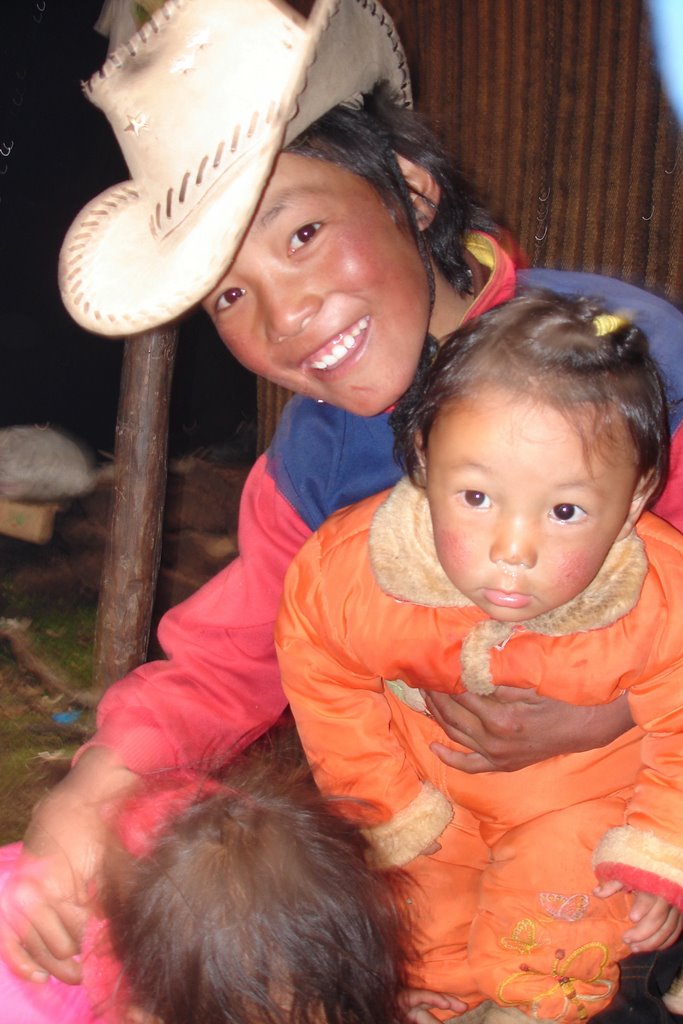
And his son in a cowboy hat. Who would suspect him?

Half an hour later I was heading back to my tent. I took some fine pictures of their camp through the fog. I struggled for a few minutes to find my campsite, but I soon found it. Everything looked cool on the home front until I went around behind my tent.

My bicycle was gone.

The loudest expletives that this part of the Tibetan Plateau has ever witnessed followed over the next few minutes. I found that my panniers were also gone. More expletives followed as I remembered that my portable harddrive, which holds every picture I have taken over the past four months, was in one of my panniers.

I should say that I locked my bicycle to my tent through a nylon loop.

The lock was smashed.

At least, I thought, he hadn't ripped my tent.

Eventually I lay down on the wet grass and yak shit to think about what I should do. At this point I own a tent, a sleeping mat, a sleeping bag, my leatherman, and a piece of bread. They also left me my three books, which was nice. Of course I still had my money which, along with the fact that I know hitch hiking is dead easy here, were my only consolations.

What to do?

I remembered that while I chatted with friend #2, friend #1 slipped out. I assumed he went to tend to the yaks. About 20 minutes later I went outside to take more pictures of yaks, and I saw friend #1 return on a motorcycle. I had my culprit. No one could have just stumbled across my campsite.

I summed up my assets: I had pictures of my two friends. I had three really heavy books. I had an awful lot of money. I had my leatherman?

Unsure that the police would be of any help - and beside they were at least five hours away - I decided to employ a diplomatic measure common in this day and age.

I'm speaking about bribery of course.

Don't get me wrong. I was scared. I decided that I should stay on the road away from the camp, and that I should not get really angry or make accusations. These guys carry twelve inch blades on their hips you realize.

This plan quickly fell through once I got close to the camp. I found friend #2 talking to a new man on the side of the road and immediately launched into some of the most fluent and emotionally charged Chinese I've ever used. It went something like:

"We've got a big problem. All my things are gone! My bicycle is stolen! I know you know who did it! I know who did it! Where's your friend? Tell him that if he returns my things, I will give him 500 yuan. My things are very important! You have one hour. I will wait on the road. If you don't return my things, I will call the police. Many many police will come. Many many! One hour!"

I didn't give him a chance to respond. They looked quite stunned. I turned around and dragged my things to a spot with a good view of the camp a couple hundred meters away. I sat down and opened Thoreau... I believe he was writing about the virtues of the savage.

I was quite confident at first. I set my alarm for one hour. This confidence faded after half an hour.

I should say that 500 yuan is a ridiculous sum of money in Chinese terms. I would guess that it is nearly a months salary for a peasant. It is about 60 American dollars.

Two motorcycles came roaring out of the camp. I thought they were doing a runner, but they turned in my direction. They pulled up and gestured for me to jump on.

Not on your life.

They insisted. Friend #2 said they would get my stuff, and that I should jump on. I told them that I was scared of them. I would walk. They took off up the road and I slowly followed. I walked about 2 km up the road, and finally saw one bike cruising across the plain towards the road. Friend #2 pulled up with all of my bags strapped on the back of his motorbike. My bicycle remained missing. He took off again and I continued up the road, looking a little strange I'm sure, barely managing to carry all of my bags. I really felt like I was in a bad movie.

I crested a hill and sat down to wait. A car load of Chinese tourists stopped to take some pictures of the view, and a passing monk strolled by and stopped to stare at me. The movie got worse. Everyone watched quietly. What the hell was this hapless foreigner up to?

I saw Friend #1 riding my bicycle across the plain towards us. "Oh shit," I thought, "these tourists are going to blow the trade". Friend #1 saw the crowd and veered off. There being a lot of witnesses, I got up and started after him. "Is it fun!?" I yelled. Seeing the situation, he thought better and turned back towards us.

Soon after I had my bicycle.

Everyone continued to stare. With the 500 yuan I had prepared still in my pocket, I started putting my panniers on my bicycle. My sweet sweet bicycle.

More staring. I finished. I looked around. The friends rode off, and a minute later so did the car load of tourists. Only the monk remained. We smiled at each other.

I decided that if I took off, they might get angry and follow me. I rode back towards the camp. They were waiting on the side of the road. I was being very cool about the whole thing since the yelling. We were almost like friends again. We all stood quietly.

"Do you still need money?"

"Only a little" replied friend #2.

I think they were relieved that I hadn't ratted on them. I gave them 50 yuan and went on my way.

I couldn't stop smiling for the rest of the day.

So it went.

If you're interested in reading a somewhat similar, though surely better and more tragic story, check out this telling by the famed Brit 2wheels, a.k.a. Edward Genochio. "Mongolian horsemen stole my bicycle"

Friday, June 30, 2006

Herdin'

Found a map of the area around XiangCheng and noticed a group of lakes just north. We set off to find the lakes, and in the end spent four days getting there and back.

Once we found the trail leading the the lakes and stashed our bikes in the forest, it was pretty easy going. The trail was over a meter wide, and followed a river up into the mountains from the mainroad for about 25 km. We later learned that the trail had been a branch of the Cha Ma Gu Dao or "The Tea Horse Trail", the famed ancient trading route that runs from China into Tibet and Myanmar.

On the second day we neared the lakes and found grasslands full of yaks and Tibetan herders. Most were from the small villages down below along the road, and said that they spent about four months grazing animals before heading down. These kids where spending the summer with Grandma. I swear that the little girl looks a little Irish. (Brett's pic)

We were making our way up to the lakes that evening when I took this picture.

The next day we went to summit a mountain overlooking the lakes in the hopes of getting a fine view and breaking 5000 meters. Though the peak turned out to be 4950 meters (over 16000 feet), the view of the lakes and surrounding valleys was spectacular. The air was thin, and so the trick was to breath heavily through your mouth as you climbed. Every 20 or 30 steps up the mountain required a little rest to catch your breath. It was cold, but well worth it.

These are the top two lakes in a chain of seven that run down the valley. There were two huge waterfalls connecting the lakes, one of which you can just see here.

While heading back to camp later that afternoon we were caught in a thunder storm. By the time we got back to camp we were soaked and freezing cold, and so we decided to head to a nearby herder's house. They had suggested that we should sleep there the night before, and we finally took them up on it.

We warmed up quickly around their fire, and eventually feasted on momos (Tibetan steamed bread), hot butter tea, boiled yak's milk, yak cheese, yak yoghurt, and bai jiu. I like Yaks.

They were up at the crack of dawn to milk the yaks. Everything was fogged in and the air was biting.

A little while later the sun crested the peaks and began to burn off the fog. By this time the four had milked over one hundred yaks and were prepared to start churning the milk.

We left their shelter a while later, full after a breakfast of butter tea and tsampa - a delicious mixture of barley flour and sugar moistened with butter tea. We bought some cheese that I've been eating on the road during the past few days. Perfect to stuff in the local pan bread with some of the chives I've been finding on the high platues.

Wednesday, June 21, 2006

up and over to SiChuan

Bought camping equipment on our last day in ZhongDian and set off on "the back road to SiChuan." Judging from it's name, I guess we should have known better what to expect. The 240 km of gravel roads over two huge passes took us four days of cycling. The first pass "Little Snow Mountain Pass" was just under 4000 m, while "Big Snow Mountain Pass" was 4360 m. We arrived in this honky tonk Tibetan town called Xiang Ba La yesterday, way in the backwoods of SiChuan, after a tiring and incredible ride though some beautiful areas.

I haven't got a map of SiChuan province yet, and so I'm having a little difficulty in orienting myself to the roads, nature reserves, and passes in the area. Fortunaly Brett has his trusty GPS, which he frequently consults. Although the maps it contains never note Chinese towns and rarely have the roads we travel on, it can report our altitude with astonishing accuracy.

A view of the peaks while climbing the first pass.

We found great campsites next to running water each night, and kept strong and healthy eating a strict diet of noodles and cookies. The last night we spent on top of "Big Snow Mountain Pass". We had considered camping up high, but in the end we didn't really have much choice. After climbing for most of the afternoon, we summited about an hour before sunset. It was crazy windy and really cold. Luckily we found an old abandoned herder's shelter just below the pass that we stayed in. It's stone walls provided the perfect windbreak, and we managed to start a fire and have tea and more noodles. Nice.

The alpine Himalaya burst into bloom over the past week. Blue and purple and yellow and white and red flowers cover the sides of most mountains. Some of the flowers are similar to those found in the Rockies, while others are unlike any I have ever seen. In this meadow we also saw many different birds and some pikas. I think that's what they were anyway... like a gopher crossed with a rabbit, only smaller.

Upon descending from the pass, we rode through a valley unlike the others. This one is steep and dry. The Barley has recently ripened, and the farmers are harvesting and threshing the crop by hand (you can see the man on the roof there is threshing hard). The Tibetan houses here are much different than those in YunNan, though still very imposing.

We met a group of backpackers upon arriving in town, and they directed us to an amazing guesthouse in one of these traditional Tibetan homes. The interior is all wood and very dark, vaulted ceilings and huge beams, with every wall covered in depictions of stories from Tibetan Buddhism painted in primary colours.

The owners don't speak English, and so Brett and I find ourselves serving as interpreters for both groups. "Can I have some sugar for my tea?" "You need to pay your bill now." "What time do you close the gates?" "How do we get to BaMu lake?" and so on ad infinitum. Maybe I will stay here for awhile and help manage the place!